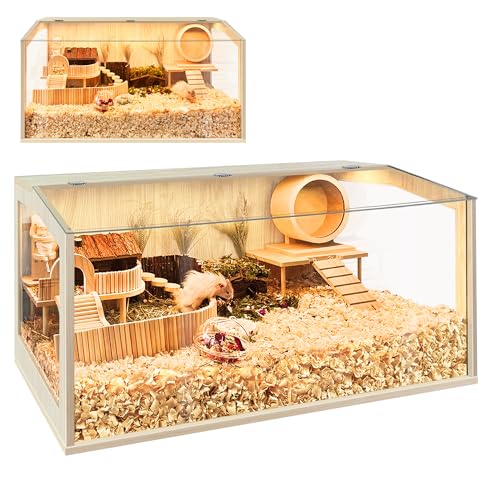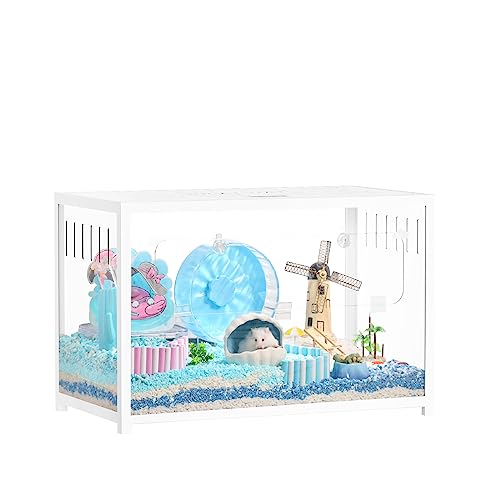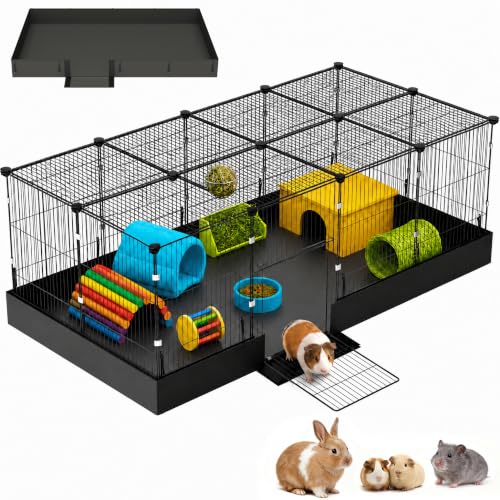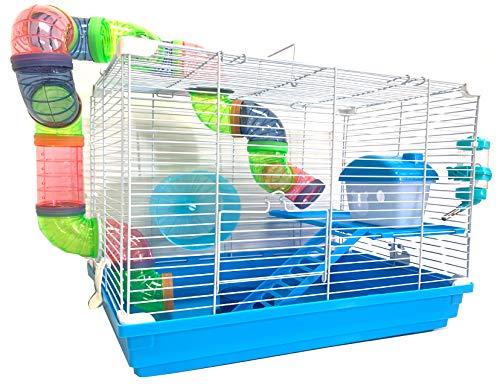
Quick answer: The Prolee Chewproof 32” Acrylic Cage is the safest first cage. It has solid panels a Syrian cannot chew through, an openable roof, and a base deep enough for real bedding. Skip any cage under 450 sq in of unbroken floor, whatever the listing totals: shelves, tubes, and upper platforms do not count. Syrians need 600 sq in, dwarfs 450 sq in (HamsterWelfare and RSPCA). Burrowers should look at the OIIBO 3-Tier Glass, the only pick here with a solid-sided base. All nine are compared below by size and breed.
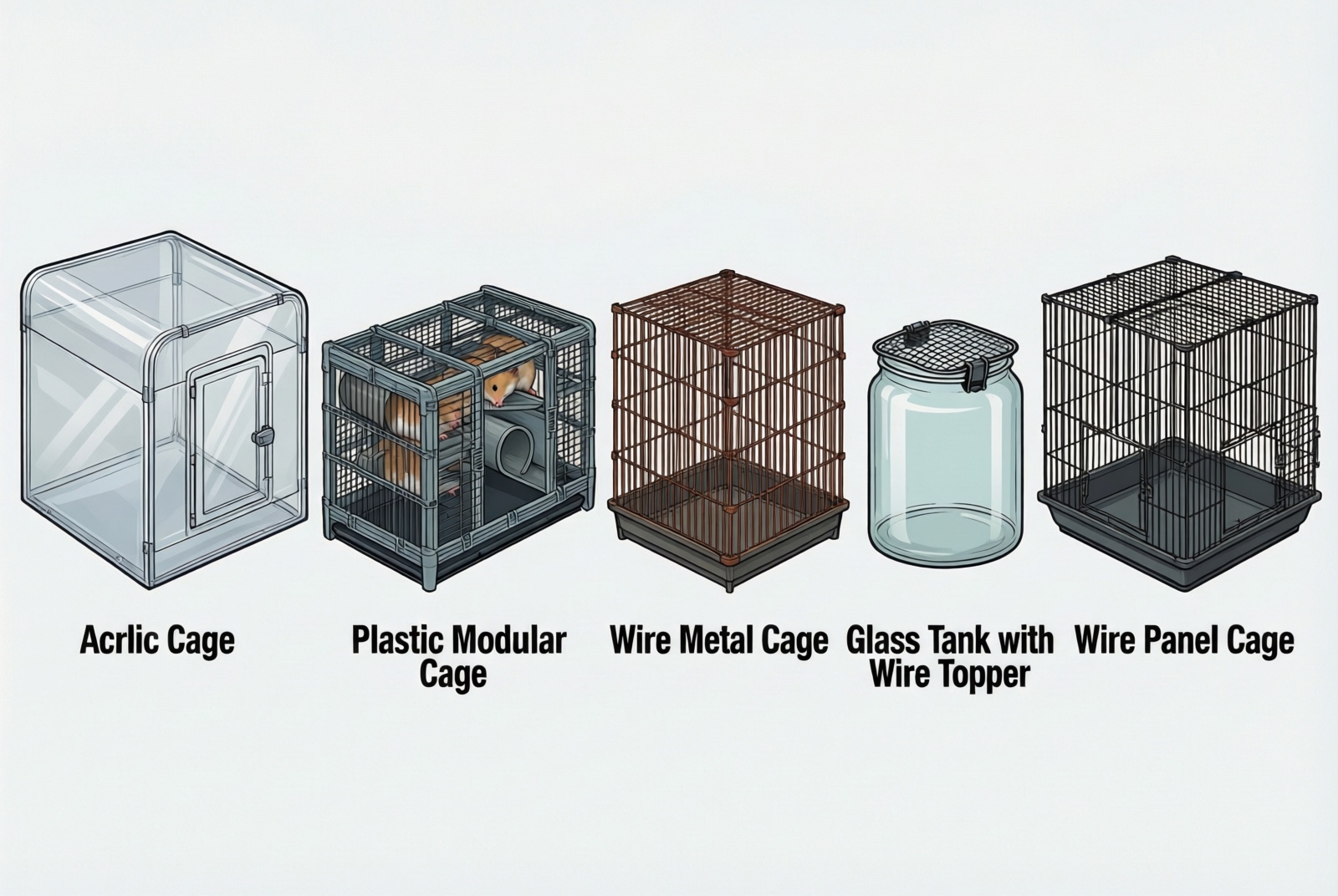
A hamster cage is any enclosure that gives a hamster continuous, solid, unbroken floor space, and that is the whole definition. A wire cage and a glass tank are both hamster cages. What separates a good one from a bad one is floor area and bar spacing, not the material on the walls. Five wall types cover nearly everything sold online: wire, plastic modular, acrylic, glass, and wooden. Each fails in a different way, so the type is a decision you make last.
Not veterinary advice: this guide covers housing and equipment. If your hamster shows signs of illness, injury, or distress, contact an exotics-savvy veterinarian rather than changing the cage and waiting.
9 Best Hamster Cages: Quick Comparison by Size
| # | Cage | Breed fit | Best For |
|---|---|---|---|
| 1 | Prolee Chewproof 32” Acrylic | Syrian + dwarf | Best overall · Check Price on Amazon → |
| 2 | Ferplast Combi 2 | Dwarf, as an add-on | Runner-up, expandable · Check Price on Amazon → |
| 3 | BUCATSTATE Metal 2.0 | Syrian | Chew-resistant Syrian setup · Check Price on Amazon → |
| 4 | Ferplast Paula | Small dwarf | Low-cost dwarf starter · Check Price on Amazon → |
| 5 | 20 Planes Enclosed | Small dwarf | Cheapest modular build · Check Price on Amazon → |
| 6 | 2-Level Habitat | Small dwarf | Everything in one box · Check Price on Amazon → |
| 7 | OIIBO 3-Tier Glass | Syrian + dwarf | Deep bedding, burrowing · Check Price on Amazon → |
| 8 | Prolee 40” Wooden | Syrian + dwarf | Looks like furniture · Check Price on Amazon → |
| 9 | 5-Floor Mansion | Dwarf climber | Vertical space · Check Price on Amazon → |
Prices on Amazon move weekly and a static number in a guide goes stale within weeks, so the table carries no price column. Every product name above is a live link: open it for today’s price, stock, and the full review pool. Read the sections below first, then buy.
Nobody on our team has run a Syrian in any of these nine cages for a season. Treat this instead as a desk comparison built from published dimensions, welfare minimums, and owner reviews. Where a claim comes from a review, the review is quoted. Where it comes from a welfare body, the body is named. Prices were read on the same day for every pick.
Best Hamster Cage Overall: 2 Picks for Beginners
A first hamster does not need the biggest or the most expensive box. It needs a cage big enough to clear the breed minimum, walls it cannot chew through, and a door that stays shut. Those three tests eliminate most of what sells well online.
If you have never kept a hamster, work through the first-time owner guide before you buy anything.
Best Overall: Prolee Chewproof 32” Acrylic Cage
The Prolee 32” acrylic enclosure solves the two problems that send new owners back to the store. One is thin plastic that a Syrian dismantles overnight. The other is wire bars spaced wide enough for a dwarf to squeeze through. Acrylic panels and a solid-wood frame leave nothing to gnaw, and the openable roof makes spot-cleaning simple.
One owner, reviewing the openable-roof version, wrote that they moved a young female Syrian out of a storage bin into this cage and called it “an EXCELLENT upgrade.” Another, comparing it against every cage they had owned before, wrote: “You name it, I’ve had it. Niteangel, Preview, Ferplast, Detolf, MeWooFun, etc… But this one might be the best. It’s not perfect, but it is soooo close.”
The negatives are real. Buyers report that the front plexiglass scratches easily and can feel flimsy, and value-for-money opinion is genuinely split. The most important gap is hardware: it ships with a single lock for one side. One verified reviewer wrote that her hamster “was able to push the corners open with just the one lock.” Add a second latch before you rely on it. Check Price on Amazon →
Skip this if you need a cage you can lift with one hand, or if your household has other pets. The lid opens wide and a determined animal will use it.
Runner-up: Ferplast Combi 2
The Combi 2 is the only pick here that grows with you. Units snap together, so you can start with one for a juvenile dwarf and add a second rather than replacing the whole cage at the next size step. The external exercise wheel is a clever use of space: it sits outside the habitat, so the floor inside stays clear for running and burrowing.
One four-star reviewer bought it as exactly that: “I bought this cage as an attachment to my larger ferplast cage. I like it for that purpose only. It is much too small to be the main cage for any size hamster.” Another noted the wheel “makes a little noise when being used.”
The one-star reviews are blunt, and you should read them before clicking buy. One verified buyer wrote: “This is horrible!!!! DO NOT BUY!!!! This cage is way to small for a hamster. If you want to get a cage make a bin cage its way better and its affordable.” There is also a supply problem: the product page shows a scarce-stock warning and the seller is a third-party reseller, not Amazon itself. Check Price on Amazon →
Skip this if you want one purchase that works for a full-grown Syrian, or if you need the cage in stock today.
Once it is home, the setup walkthrough covers bedding depth, first-week handling, and wheel placement.
Hamster Cages by Size and Breed: Syrian, Dwarf, Chinese, Roborovski
Pick the breed first, take the floor number for that breed, and only then look at products. Reversing that order is how people end up with a beautiful cage that is too small. Breed-by-breed behaviour is covered in the Syrian hamster guide.

Syrian (600 sq in min): BUCATSTATE Metal 2.0
A Syrian reaches six to seven inches long and chews through anything thin. The BUCATSTATE Metal 2.0 answers that directly with an all-metal frame: no plastic to destroy, and enough interior to carry two wheels and several hides at once. The front-opening door means you can reach in without lifting the roof.
Assembly is the surprise win. One verified buyer wrote that it took “like 15 minutes MAX to set up and it was done.” Another said it came with the only tool needed, a screwdriver, included.
Now the honest part. Buyers report that it is not actually chew-proof, that sturdiness and chew resistance get mixed reviews, and that the lid and door hardware do not always last. One one-star review reads: “Poor quality. Paid to much money to have to replace parts every year… The lid should not warp and not close risking the safety of our pet hamster getting out.” A two-star review reports arriving damaged: “most of the metal pieces were bent and had to be fixed with pliers.” Inspect every piece before assembly. Check Price on Amazon →
Skip this if you want a lightweight cage you can carry between rooms, or if you are not comfortable aligning metal parts with a screwdriver.
Dwarf, Winter White, Campbell’s, Chinese (450 sq in min): Ferplast Paula
The Ferplast Paula is designed for small hamsters and mice, and it is the pick with the largest body of owner feedback in this guide. The connecting tube adds run and climb, and owners consistently mention that it gives their hamster room to move around. One five-star reviewer wrote that the wheel was too small for her hamster and she simply swapped it: “The hamster, aka Rosemary, seems to love her new place. She roams and climbs all over in it.”
Be clear-eyed about the size. The published product dimensions are 18.11 inches long by 11.61 inches wide, which works out to roughly 210 sq in of base. That is under half the 450 sq in dwarf minimum, and the reviews say the same thing. One owner wrote: “I have discovered this cage is not only unsuitable for a Syrian hamster, but it is unsuitable for ANY species of hamster due to its size.” Treat it as a first-season cage, then move up. Other recurring complaints: cages arriving bent, a bundled water bottle that does not work, and awkward disassembly. Check Price on Amazon →
Skip this if you want one cage to last a full two-to-three-year lifespan, or if your hamster is already adult-sized. Modular add-on units do exist in this category, but none were verified for this roundup, so nothing is recommended by name. Judge any add-on on the same three tests: does it add floor space, does it latch, and does it join to the base without gaps.
Roborovski (0.4” or less bars): no pick here qualifies
Roborovski hamsters are three inches long and fit through gaps that would stop a Syrian. They need 0.4 inch or less between bars, the tightest requirement of the four common species. Honest answer: none of the nine cages in this guide is a purpose-built Roborovski cage, and pretending otherwise would get a small hamster hurt. Check every bar gap and connection point yourself with a ruler, and see the dwarf hamster cage guide for the full species breakdown.
Chinese: 450 sq in, treat it like a large dwarf
Chinese hamsters are the biggest of the dwarf species, so they take the same 450 sq in floor minimum and a wheel one size up. The practical difference is strength: a Chinese chews harder and faster than a Winter White, so plastic cages are a short-term choice at best.
Budget Hamster Cages: Small Bills, Real Limits
Entry-tier cages are where most first-time buyers land, and they are also where the size problem concentrates. You can get a real enclosure cheaply, but you usually have to choose between enough floor space and walls that survive a determined chewer. Both together is premium-tier territory.

Best Budget: 20 Planes Enclosed Cage
The cheapest verified pick in the lineup, and the only entry-tier option built from modular panels. Twenty panels let you reshape the footprint to fit your space, and the waterproof tray makes cleaning faster than open-grid floors. One buyer wrote: “He love it, easy to set up. Straightforward instructions and it makes cleaning easy. Plenty of space for him to roam and run if he so chooses.”
The failure modes are specific. Several buyers report the elastic straps that hold the liner up unravelling and coming off. One wrote that the liner is “decidedly NOT waterproof.” One-star reviews are common enough here that you should expect to read them. A Spanish-language one-star review is blunt about the marketing: the listing photo shows the cage for rabbits and guinea pigs, and the reviewer says it is “definitivamente no es para conejos.” It is a hamster and small-rodent cage, and the panels flex under a Syrian’s weight. Check Price on Amazon →
Skip this if your hamster is a Syrian, or if you want deep bedding. The floor is shallow and the panels need every connector seated correctly to stay rigid.
Budget Runner-up: 2-Level Habitat
Everything arrives in one box: wheel, water bottle, food dish, and platforms. For someone who wants a working setup on the first afternoon, that is the appeal.
The build is the problem, and buyers say so in plain words. One-star reviews are the biggest single block of feedback on this listing, and they all point the same direction. A verified one-star review reads: “Don’t buy it is not worth the money! Very thin small and flimsy doesn’t stay together! It’s just junk! The cheap plastic isn’t tall enough to put a sufficient amount of bedding in it.” A three-star reviewer added that the shelves are “super thin” and some “came in bowed.”
A necessary note on evidence: this listing and the 5-Floor Mansion below are variants under the same parent, and they share one review pool. Their complaint patterns are the same data seen twice, not two independent verdicts. Check Price on Amazon →
Skip this if you are buying for a Syrian, or if you will not spend an evening fixing clips and shoring up shelves.
Best Multi-Level Wire Cage: Large 5-Floor Hamster Mansion
Five stacked levels with safety rails, and the cheapest verified vertical space in the lineup. For a dwarf that genuinely climbs, the geometry is appealing, and it is the only pick built around height rather than footprint.
The warnings match the 2-Level Habitat above, because the review pool is shared, not because the products are identical: “the cage is not sturdy, with tubes being flimsy and platforms falling down,” and one one-star reviewer wrote that it “is not worth the money! Very thin small and flimsy doesn’t stay together!” It sits at the bottom of this guide on buyer satisfaction, and the complaints above are the reason. Check Price on Amazon →
Skip this if you keep a Syrian. Falls from the upper levels cause real injury, and a Syrian is a ground animal that digs rather than climbs. Also skip it if small children will lean on the platforms.
The better budget route is a build. A large storage bin with a solid base gives you more usable floor space than any entry-tier cage. It cannot be chewed, and it costs less than the cages on this list. The DIY bin cage guide covers the drill, the vent layout, and the bedding depth that makes it work.
Best Glass and Wooden Hamster Cages: Burrowing and Furniture
Two picks, two different reasons to spend. One trades weight and cleaning effort for bedding depth, because a Syrian that cannot dig eight inches into substrate will try to dig eight inches into the acrylic instead. The other trades sturdiness for a living-room look.
Best Glass Tank: OIIBO 3-Tier Glass Cage
This is the only pick in the guide with a fully solid-sided base. That makes it the only one that can hold the 8 to 12 inches of bedding that serious burrowing requires. The wire topper adds two shelves, two ladders, and ramps above the glass base for climbing, with an openable top for access.
Owners rate the digging space highly, and one long-term review shows a problem getting solved: “Update Three Years Later: My gerbils have lived in and loved this OIBO cage for the entirety of their lives. The gap I mentioned in the original part of my review was remedied when I discovered a part still in the box that I hadn’t installed.”
The caveats are physical. The glass base makes this a two-person lift, and the top add-on is described as feeling “cheap-ish.” Cleaning is the most common complaint. Shipping damage is reported too: “glass was cracked in a corner. Not bad enough to return because this isn’t an aquarium, but still sad. Second, the plastic liner at the bottom was broken.” One one-star review describes a gerbil getting a claw caught in the fine topper mesh within minutes. Check every mesh panel and install every part first. Check Price on Amazon →
Skip this if you live above ground floor, move cages often, or want a weekly clean that takes under five minutes. Glass is a burrowing trade, not a convenience one.
Best Wooden Cage: Prolee 40” Chewproof Enclosure
The one pick here that solves a problem none of the others address: a hamster cage that does not look like a hamster cage. Bite-resistant wood with acrylic viewing panels and a 270-degree panoramic window reads as a piece of furniture, so it can sit in a living room instead of a corner. The openable top makes decorating and deep bedding straightforward. One owner wrote: “It looks very sleek and is massive! My Syrian girl is beyond happy! It allows for deep bedding and lots of room for enrichment.”
Buyers disagree about the build, and the minority opinion matters. Reviews split on sturdiness, and some find the wood too thin. A three-star reviewer flagged the front acrylic panel as loose: “I’m not a fan of the sheet of plexiglass on the front though, as it moves around a lot.” Fewer owners have reviewed it than the other picks here, so read the complaints as carefully as the praise. Check Price on Amazon →
Skip this if you need a cage that survives a Syrian’s full adult strength without reinforcement, or if moving it is part of your cleaning routine.
If a Syrian is chewing through plastic, the fix is material and enrichment, not a stronger clip. the stop-cage-chewing guide covers that, and the dinosaur cage article covers novelty shapes.
Wire vs Glass vs Wooden: which cage type fits your hamster?
Material is the last decision, not the first. Once the cage clears the floor minimum and the bar spacing is safe for your hamster’s breed, the wall material decides what the animal can do inside. It decides whether the hamster can dig, climb, or just sit.
| Wire cage | Glass tank | Wooden enclosure | |
|---|---|---|---|
| Chewed through | Yes, unless coated | No | Rarely, if wood is thick |
| Bedding depth | Shallow, tray-limited | Deep, 8” to 12” possible | Deep, panel-dependent |
| Ventilation | Best | Weakest, needs top vents | Good |
| Cleaning | Easiest, open access | Hardest, heavy glass | Moderate |
| Weight | Light | Heaviest | Heavy |
| Noise | Quiet | Quiet | Quiet |
| Looks like furniture | No | Sometimes | Yes |
| Expandable or modular | Some models, by joining panels | No | No |
| Moving it between rooms | Easy, it is light | Two-person lift | Heavy but manageable |
| 1★ share in the reviews quoted here | 18% (one shared parent pool, counted once) | 9% | 5% |
| Best for | Budget, dwarf, tall builds | Burrowing | Living rooms, Syrians |
For most owners the choice collapses to one question: is your hamster a burrower? If yes, glass or wood. If no, wire is fine and cheaper, provided the floor and bars pass the numeric checks below.
The review data behind those rows is not equal, and that shapes how much weight each column carries. Every rating and review count in this guide was read from the Amazon product page on September 30, 2026, at delivery ZIP 10001. The two wire budget cages share a single parent listing, so their 3,236 reviews are one pool counted once, not two; together they carry the largest pool in the lineup and the lowest averages at 3.6 stars. The glass tank sits at 4.1 on 133 reviews, the thinnest sample here. A small pool is not a defect, but it is the reason the long-ownership quotes above come from people who kept a hamster cage for years rather than weeks.
Two honest limits on those numbers. First, review counts are not stable enough to treat as precise. The 32-inch acrylic enclosure was published at 594 reviews on September 27 and read 218 on September 30, a 63% drop in three days. That is the only gap of its kind in this set: the other listings moved by a few percent or stayed flat, and if Amazon were simply counting a parent listing differently from a child listing, every listing here would show a gap. So we could not establish what caused this one, and we have not guessed. Treat that count as not verifiable rather than as a precise figure. Second, this guide recommends 9 products drawn from 7 distinct parent listings, so 2 pairs come from the same parent. The two wire cages show an identical rating and count, which is direct evidence that one pool was read twice. The two Prolee enclosures show different counts, so we cannot say how Amazon is aggregating that parent, and we have not treated their reviews as independent confirmation of each other. Where a pool is shared the complaints overlap by nature, and we have counted those complaints once.
Hamster Cage Size Requirements by Breed: 450 and 600 sq in
The numbers below are the floor, not the target. HamsterWelfare and the RSPCA set the welfare minimums, and the PDSA and German TVT set the bar-spacing limits.
| Breed | Min floor space | Min dimensions | Bar spacing | Wheel size |
|---|---|---|---|---|
| Syrian | 600 sq in | 36” x 18” | 0.7” or less | 8.5” to 10” |
| Winter White / Campbell’s | 450 sq in | 30” x 15” | 0.5” or less | 6.5” to 7” |
| Chinese | 450 sq in | 30” x 15” | 0.5” or less | 7” to 8” |
| Roborovski | 450 sq in | 30” x 15” | 0.4” or less | 6” to 6.5” |
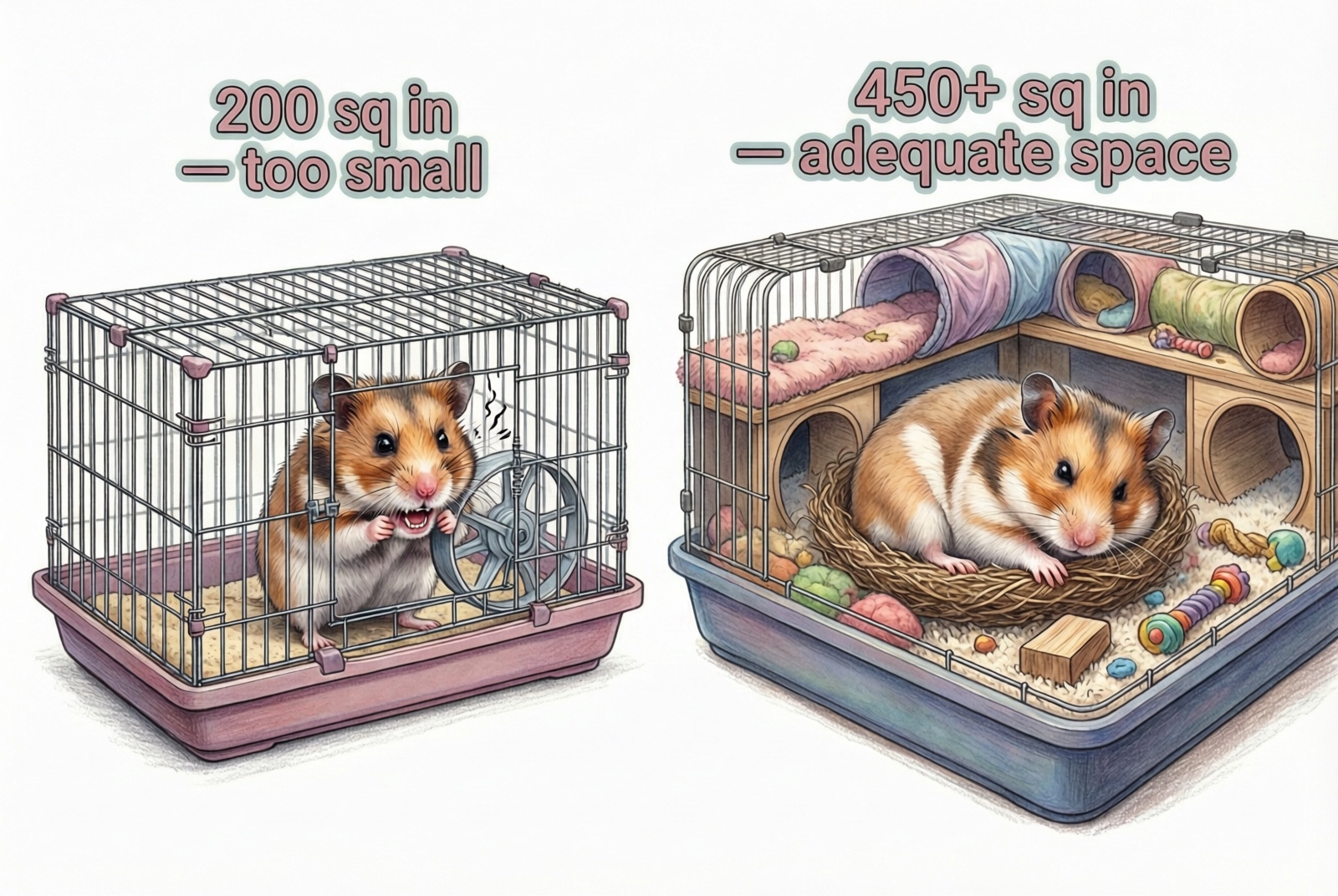
Count the base only. Take the inside dimensions of the floor, multiply length by width, and stop. A cage with 300 sq in on the base and 200 sq in of shelf space does not reach 450. Listings that reach 500 sq in by counting shelves, tubes, and ramps are counting furniture, not floor.
If the listing quotes square feet, convert before you compare. One square foot is 144 square inches, so 450 sq in is 3.1 sq ft and 600 sq in is 4.2 sq ft. The arithmetic makes the targets concrete: a 30” x 15” base is 450 sq in, a 36” x 18” base is 648, and a 32” x 20” base is 640 and clears the Syrian number with room to spare. A cage listing that advertises a much larger total is usually adding platforms to that base figure, which is exactly what the square-foot conversion makes obvious.
Height does not buy floor area. A tall narrow cage is not a big cage. Twelve inches of height is worth having because it lets you hold at least 6 inches of bedding. One deep corner at 10 to 12 inches is what makes burrowing possible. Beyond that, extra height sits empty.
The biology is not complicated. In the wild a Syrian digs horizontal burrows several feet long and does not climb trees. Every platform you add above the base comes out of the animal’s floor space.
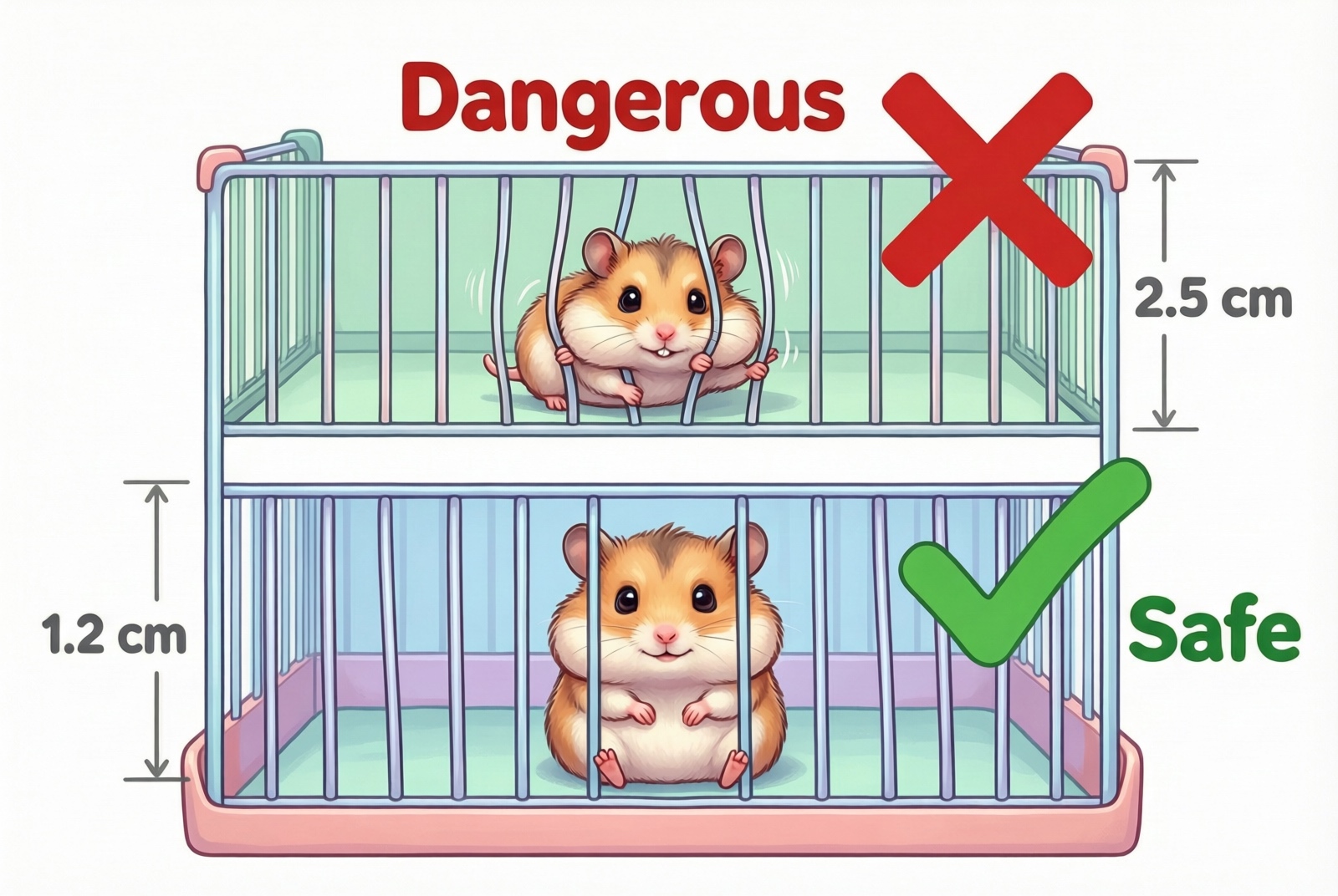
Bar spacing decides escapes, not height. A dwarf can squeeze through a gap that would stop a Syrian, and 0.4 inch for Roborovski is a hard limit rather than a target. For the wheel sizes in the breed table above, see the hamster wheel size chart.
Two hamsters, one cage. No, not for Syrians. They are strictly solitary and pairing them risks serious or fatal fighting. Some dwarf species can share a same-sex pair if introduced young, but you need a separate cage ready in case it does not work. For the size picture per breed, the Syrian cage size guide goes deeper on the 600 sq in side, and the proper enclosure guide covers the full welfare standard.
How Beginners Choose the Best Hamster Cage: 5 Steps + Setup Checklist
You do not need to understand cage construction to get through these five steps. Each one is a number or a measurement, and each eliminates a category of mistake before you spend anything.
-
Pick the breed, then take the number. Syrian needs 600 sq in of continuous floor, dwarf needs 450 sq in. If you have not decided on a species yet, decide first, because this one number rules out most starter kits sold online.
-
Set the budget and the material together. Mid-tier pricing is where chew-resistant acrylic and sturdy plastic live. Below entry-tier you choose between meeting the size minimum and surviving chewing, and you cannot have both in one cheap box. Decide which one you are giving up.
-
Check bars, ventilation, and the latch with a ruler. Measure the bar gap against the 0.4 inch to 0.7 inch limits in the table above. Open the door and pull the latch hard. Thin latches are the most common cause of escaped hamsters and the cheapest thing to fix with a clip.
-
Measure the spot before you order. A 32” to 40” cage is wider than most side tables, and the wall clearance needed for a ventilated top counts too.
-
Budget the inside of the cage separately. Bedding, a solid-surface wheel, a sand bath, two hideouts, and chew toys are a one-time cost that rivals the cage itself. A large empty enclosure is still an empty enclosure.
First-week setup: from unboxed to settled
The five steps above decide which hamster cage you end up with. These six happen after the box opens, in this order, and running them in sequence is what keeps a first week from going wrong.
- Confirm the floor before any bedding goes in. Measure the inside base, multiply length by width, and compare against 600 sq in for a Syrian or 450 sq in for a dwarf. If it falls short, the hamster cage is already the wrong one, and no amount of decoration puts the number back.
- Run a finger along every bar gap and every latch before the animal is anywhere near it, using the breed limit from the table above. Single-latch doors need a second lock fitted that same day.
- Pour bedding deep rather than flat. Six inches across the floor, ten to twelve in one corner, paper-based or aspen only. Untreated pine and cedar damage airways, and fluffy cotton bedding causes intestinal blockage if it gets eaten.
- Split the wheel and the sand bath across the enclosure so digging and running do not fight over the same corner. Solid-surface only, and 8.5 inches is the floor for a Syrian.
- Place two hideouts apart from each other. One is a hiding place; two make it a choice. A hamster forced to share a single tunnel picks a corner and paces in it.
- Leave the new hamster cage quiet for the first three days. Sit near it, talk softly, and let the animal emerge on its own. Handling by hand starts once it is eating and nesting normally, not before.
The 30-second checklist
Floor space, from HamsterWelfare and RSPCA minimums:
✅ At least 600 sq in of continuous floor for a Syrian hamster
✅ At least 450 sq in of continuous floor for a dwarf hamster
✅ Measure the inside floor, not the outer packaging
❌ Do not count shelves, tubes, or upper platforms toward the total
❌ Do not buy an undersized cage with a plan to upgrade later, because most owners never do
Bars and ventilation, from PDSA and German TVT guidance:
✅ 0.5” or less for Winter White and Campbell’s dwarfs
✅ 0.4” or less for Roborovski dwarfs
✅ 0.7” or less for Syrian hamsters
❌ Never a wire-bottom floor, which causes foot injury
❌ Never a fully sealed solid cage with no secondary ventilation
❌ Keep the cage out of direct sun, off drafts, and away from a TV speaker
Bedding depth, following Blue Cross and AWF recommendations:
✅ At least 6 inches of bedding throughout the cage
✅ 10” to 12” in one corner so a burrow can be dug
✅ Paper-based or aspen bedding only
❌ No untreated pine or cedar, which damages airways
❌ No fluffy cotton bedding, which causes intestinal blockage if eaten
Inside the cage:
✅ Solid-surface exercise wheel, 8.5” minimum for a Syrian and 6.5” for a dwarf
✅ Sand bath with chinchilla sand, not dust, for grooming
✅ At least two hideouts placed apart from each other
❌ No wire mesh wheels, which injure feet and backs
Housing:
❌ Never two Syrian hamsters in one cage
❌ Never introduce an adult Syrian to another hamster at any age
✅ Same-sex dwarf pups from one litter may share if introduced young
To fill the cage once it passes, work through the cage enrichment guide and the hamster toy picks. For a second species, the same floor-space logic applies elsewhere: see the best guinea pig cage and the best rabbit hutch, which run to different minimums.
Which Best Hamster Cage Should You Buy: Final Verdict
One situation, one line each. Every entry names the pick and the reason to skip it.
- First hamster, any breed → the Prolee Chewproof 32” Acrylic. It clears bar spacing and chewing in one design. Skip it only if you need a cage you can carry one-handed, and add a second latch before the hamster finds that gap.
- Syrian, chewing through plastic → the BUCATSTATE Metal 2.0. Nothing to gnaw on. Skip it if you are not willing to check the bent-and-chipped pieces that shipping sometimes delivers.
- Dwarf on a tight budget → the Ferplast Paula. Skip it if you want one cage for the full lifespan, because its published base is well under the 450 sq in minimum. A bin build beats it outright.
- Wanting to start small and expand later → the Ferplast Combi 2. Skip it as a standalone unit, and check stock first because the listing runs scarce.
- Burrowing is the point → the OIIBO 3-Tier Glass. Skip it above ground floor or if fast cleaning matters more than bedding depth.
- It has to look like furniture → the Prolee 40” Wooden. Skip it if a light-weight build matters, and check the front acrylic panel for wobble.
The numbers decide everything else. A dwarf needs 450 sq in and a Syrian needs 600 sq in. Bar gaps go from 0.4” to 0.7” depending on breed, and bedding needs to be at least 6 inches deep with one deep corner. A cage that clears those four checks will not be exciting in a listing photo, and it will be the difference between a hamster that burrows and one that paces. For overnight monitoring once it is set up, the pet camera picks are worth a look. Ferret and bird owners are better served by the best ferret cage and the best bird cage, which follow different welfare standards entirely.