Quick Answer: Can Budgies Eat Apples?
Yes — apples are one of the best fruit treats you can offer your budgie, provided you remove the seeds and core first. The key safety rule is simple: no seeds, ever.
💡 TL;DR: 1-2 thin apple slices, two to three times per week. Remove all seeds and the core. Wash thoroughly. Cut into small pieces. Apples are lower in sugar than most fruits (10.4g per 100g), provide good fiber and hydration, and most budgies enjoy the crunch.
Apple seeds contain amygdalin, a compound that releases cyanide when digested — dangerous for a bird weighing just 25-40 grams. The good news is that removing seeds takes about five seconds and eliminates the risk entirely. The flesh is perfectly safe, nutritious, and most budgies genuinely enjoy the crunch.
In my experience, apples are one of the easiest fruits to introduce. The mild flavor appeals to even picky eaters, and I’ve used thin apple slices as training incentives reliably. They’re widely available year-round. For cockatiel-specific portions, see our can cockatiels eat apples guide.
Apple Nutrition Facts for Budgies
Harrison’s Adult Lifetime Fine (TOP PICK) is a quality option worth considering for your setup.
USDA nutritional data — raw apples with skin, per 100g USDA FDC ID 09003 — “Apples, raw, with skin”:
| Nutrient (per 100g) | Amount | Relevance to Budgies |
|---|---|---|
| Energy | 52 kcal | Low calorie density |
| Protein | 0.26g | Very low protein |
| Fat | 0.17g | Very low fat |
| Carbohydrate | 13.8g | Moderate carbohydrate |
| Fiber | 2.4g | Good fiber — digestive health |
| Sugar | 10.4g | Moderate — one of the lower-sugar fruits |
| Water | 85.6g | Good hydration |
| Calcium | 6mg | Low calcium |
| Phosphorus | 11mg | Low phosphorus |
| Potassium | 107mg | Good potassium — heart and muscle |
| Vitamin C | 4.6mg | Moderate vitamin C |
| Vitamin K | 2.2µg | Moderate vitamin K |
| Vitamin A | 54 IU | Low vitamin A |
| Quercetin | Present in skin | Antioxidant (anti-inflammatory) |
Why Apples Score Better Than Most Fruits
At 10.4g sugar per 100g, apples are lower in sugar than grapes (15.5g), mango (13.7g), and banana (12.2g). The fiber content (2.4g) helps slow sugar absorption. At 85.6% water, apples also provide meaningful hydration.
| Fruit | Sugar (g/100g) | Fiber (g) | Budgie Frequency | Portion |
|---|---|---|---|---|
| Apple | 10.4g | 2.4g | 2-3x/week | 1-2 thin slices |
| Grapes | 15.5g | 0.9g | 1x/2 weeks | Half grape |
| Blueberries | 10g | 2.4g | 2-3x/week | 1-2 berries |
| Strawberry | 4.9g | 2g | 2-3x/week | Half berry |
| Banana | 12.2g | 2.6g | 1-2x/month | Tiny piece |
Apples sit in a sweet spot: moderate sugar, good fiber, easy to prepare. They’re not the lowest-sugar fruit (strawberries win there), but the fiber-to-sugar ratio is one of the best.
Apple Skin vs Flesh — Nutrition Comparison
| Nutrient | Flesh (per 100g) | Skin (per 100g) |
|---|---|---|
| Fiber | 1.3g | ~4-5g |
| Quercetin | Very low | High |
| Vitamin C | Similar | Similar |
| Pesticide residue | Lower | Higher |
The skin contains significantly more fiber and quercetin (a flavonoid antioxidant with anti-inflammatory properties) than the flesh. If you feed organic apples with properly washed skin, your budgie gets a nutritional bonus. For conventional apples, peeling is the safer choice due to pesticide residue — the skin traps more chemicals than the flesh.
Apple Varieties
| Variety | Sugar (per 100g) | Best For |
|---|---|---|
| Granny Smith | ~7g | Best choice — lowest sugar |
| Golden Delicious | ~10g | Good all-around |
| Gala | ~11g | Popular, slightly sweeter |
| Fuji | ~14g | Highest sugar — avoid |
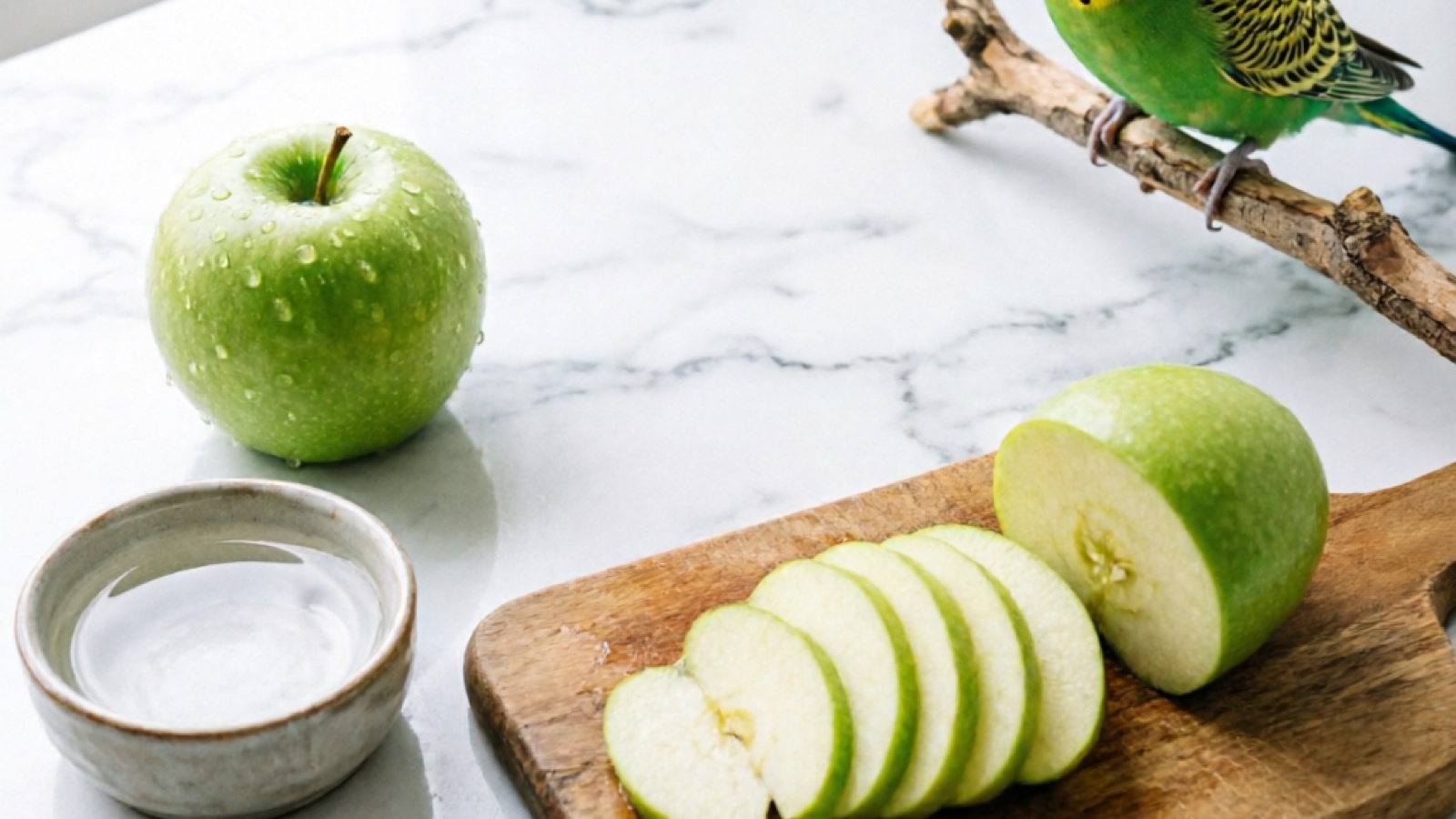
Granny Smith is the clear winner at roughly 7g sugar per 100g. Its tartness is actually appealing to many budgies — in my experience, they enjoy the crunch more than sweetness level.
Benefits of Apples for Budgies
Many owners find that Higgins Mayan Harvest works well for their pet’s needs.
Good Fiber for Digestion
At 2.4g per 100g (and up to 5g if you include the skin), apples provide meaningful dietary fiber. Fiber supports healthy gut motility and helps prevent crop impaction, which can occur in birds that eat mostly dry seed diets. The fiber in apples also helps slow the absorption of sugar into the bloodstream, which is important for a bird this small.
Moderate Sugar — A Better Choice Than Most Fruits
At 10.4g per 100g, apples have significantly less sugar than grapes (15.5g) and banana (12.2g). This makes them a safer “regular” treat — two to three times per week is reasonable, compared to once every two weeks for grapes. The moderate sugar content means you can offer apples more frequently without the same level of concern.
Hydration
At 85.6% water, apples provide good hydration support. This is particularly useful during warm weather or in dry indoor environments. Many budgies enjoy the juiciness of fresh apple, which encourages them to eat. Proper hydration supports kidney function, helps maintain healthy droppings, and aids in feather condition.
Vitamin C
At 4.6mg per 100g, apples provide moderate vitamin C for immune function. While budgies synthesize their own vitamin C in the liver (unlike humans, who cannot), supplementary dietary vitamin C still supports overall immune health, especially during times of stress such as molting, relocation, or illness.
Potassium
At 107mg per 100g, apples contribute meaningful potassium for proper heart rhythm, muscle function, and nerve signaling. This is a secondary benefit but supports overall metabolic health in active budgies.
Quercetin (In the Skin)
Quercetin is a flavonoid antioxidant found in apple skins that has anti-inflammatory and immune-supporting properties. If you feed organic, properly washed apple skin, your budgie gets this bonus nutrient. Quercetin has been studied for its potential to reduce inflammation and support cardiovascular health.
Enrichment and Training Value
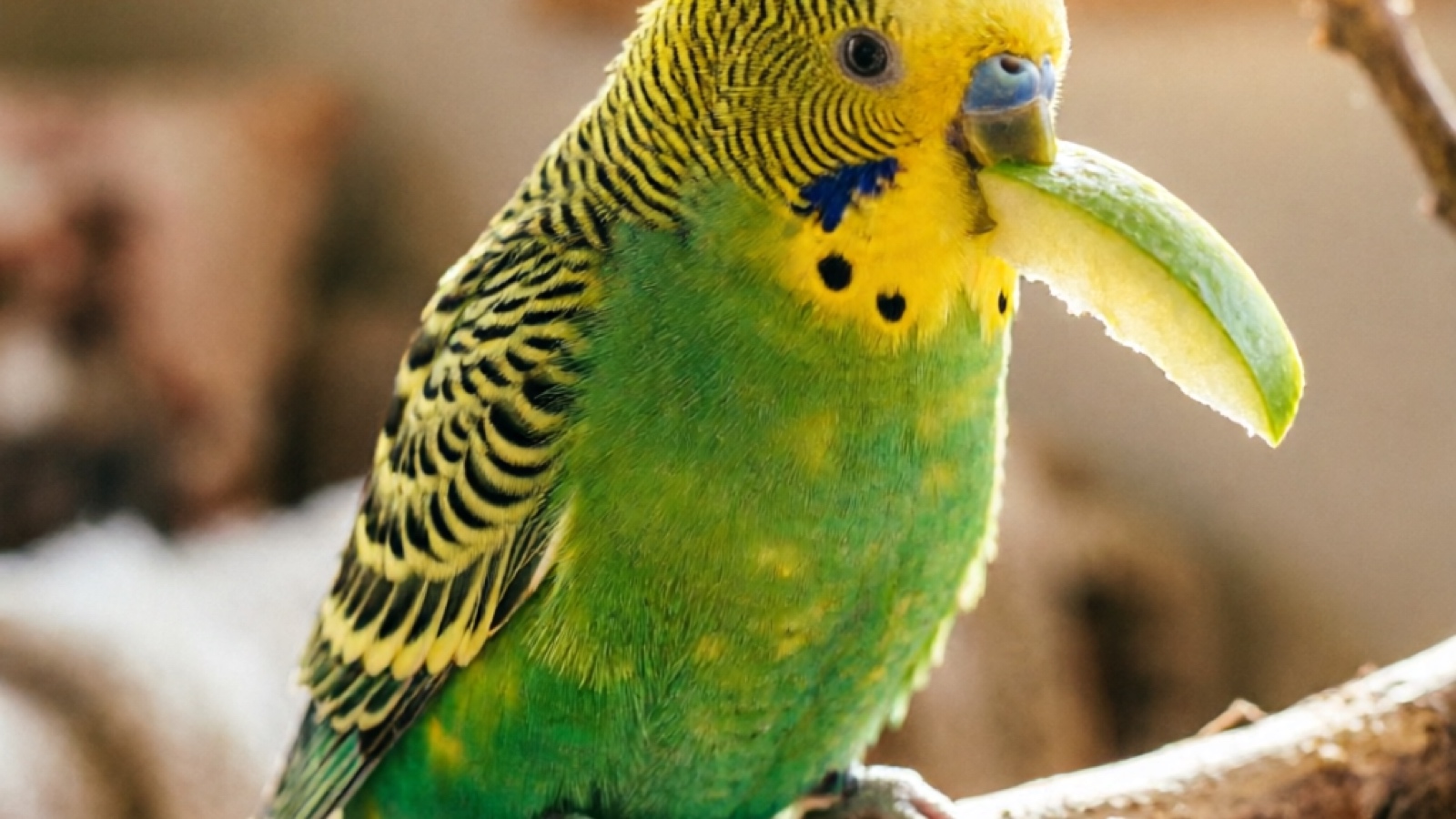
Apples provide excellent enrichment value. The crunch is satisfying, the mild sweetness is motivating, and budgies will often hold apple pieces with their feet while eating — a natural behavior that provides mental stimulation. I’ve found apple slices to be among the most effective training treats for budgies, second only to grapes in motivation value but far safer for regular use.
Easy to Prepare and Store
Apples are available year-round, store well in the refrigerator for weeks, and require minimal preparation — wash, cut around the core, remove seeds, slice. There’s no peeling required if you buy organic, and even with conventional apples, a quick peel adds only seconds. This practical convenience means you’re more likely to actually offer them regularly.
Risks and Precautions
For this purpose, Vitakraft Vita Smart is a popular choice among pet owners.
Apple Seeds — The Primary Danger
Apple seeds contain amygdalin, a cyanogenic glycoside. When digested, gut bacteria break down amygdalin and release hydrogen cyanide into the bloodstream, which blocks cellular oxygen transport.
For a 25-40g budgie, the margin of safety is thin — each apple seed contains approximately 0.6-2.4mg of amygdalin, and the toxic dose for small birds is estimated at just a few milligrams. Even one or two crushed seeds could be dangerous.
Symptoms of cyanide poisoning: lethargy, difficulty breathing, drooping wings, and seizures in severe cases. If your budgie has eaten apple seeds, contact an avian veterinarian immediately.
Prevention is trivial: cut around the core and remove every seed. This takes five seconds and completely eliminates the risk. I always cut a wedge away from the core, then inspect for any seed fragments before serving.
Apple Stems and Leaves
Apple stems and leaves also contain cyanogenic compounds and should be removed along with the seeds. Discard the entire core — don’t try to salvage any part of it.
Sugar — A Secondary Concern
While apples are lower in sugar than many fruits, 10.4g per 100g is still significant for a 30-gram bird. A thin apple slice weighs roughly 3-5g and contains about 0.3-0.5g of sugar. This is within a budgie’s treat sugar budget (roughly 1-2g per day from all treats combined), but only if you’re not also offering other sugary foods on the same day.
Chronic excess sugar in budgies causes:
- Fatty liver disease (hepatic lipidosis): The most common diet-related killer in pet budgies
- Obesity: Shortened lifespan, reduced activity, respiratory vulnerability
- Diabetes: Increased thirst, watery droppings, weight loss
- Behavioral changes: Hyperactivity, aggression, excessive screaming
Pesticide Residue
Apples consistently appear on the Environmental Working Group’s Dirty Dozen list. For a 30-gram budgie, proportional pesticide exposure is far more dangerous than for humans. Conventional apple skin can carry significant residue. Thorough washing is essential, and peeling is the safest option for non-organic apples:
- Wash under cool running water for 15-20 seconds
- Use a produce brush for extra cleaning power
- Soak in 1:3 vinegar-water solution for 2-3 minutes
- Rinse again thoroughly
- Organic apples are strongly preferred — especially if leaving the skin on
Choking Hazard
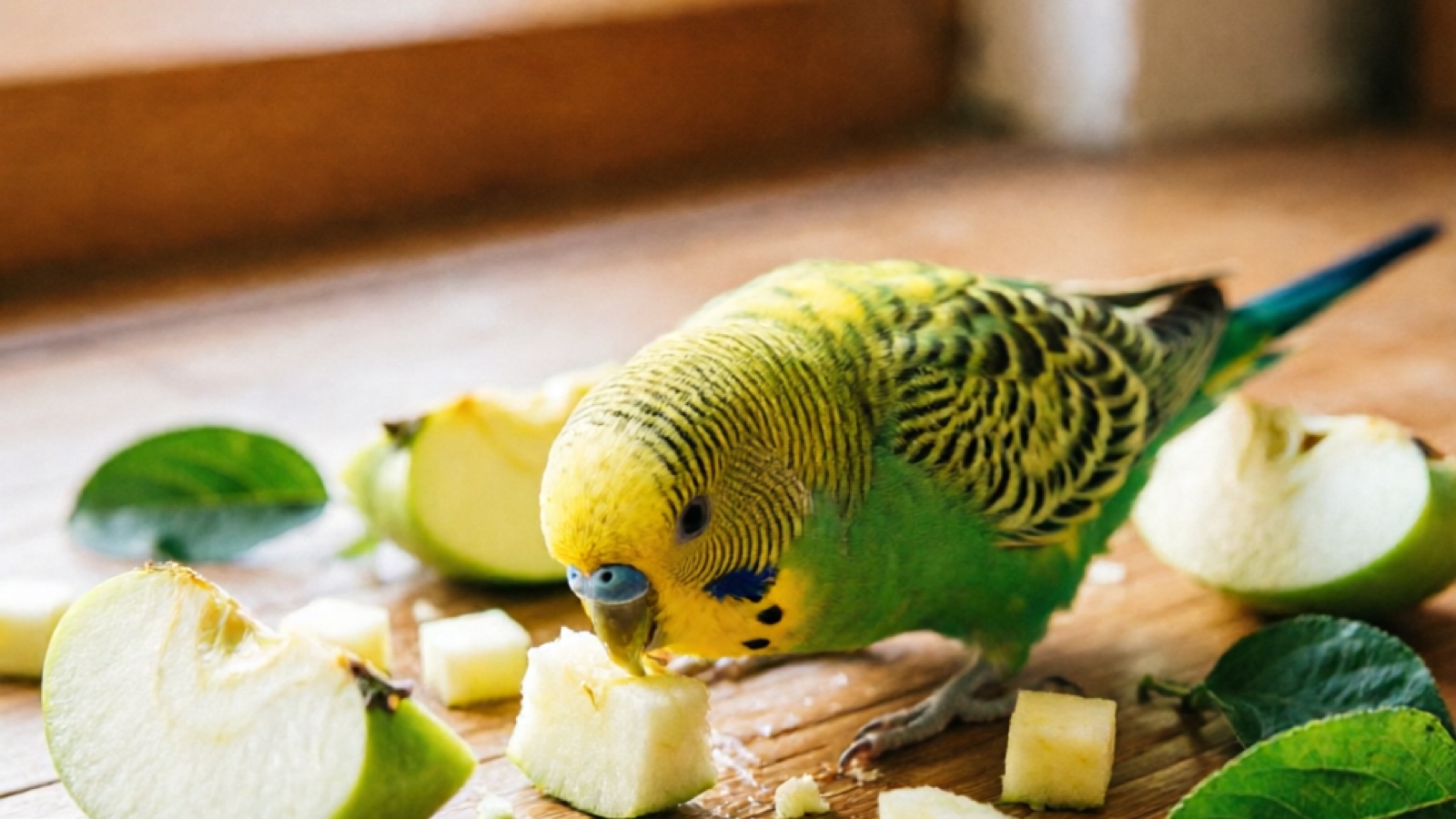
Large chunks of apple can be a choking risk for small budgies. Always cut apple into thin slices or small half-inch cubes. A piece that’s too large can get stuck in the crop or throat. For very small budgies (25-30g), aim for pieces roughly the size of a sunflower seed.
Digestive Upset
Introducing apple too quickly or in too large a quantity can cause loose droppings. The high water content combined with fruit sugar can temporarily speed up gut transit. Introduce apple gradually — start with a single small piece and observe droppings for 24 hours before increasing the portion.
Serving Guide for Budgies
American / Standard Budgies (25-35g)
- Amount: 1 thin apple slice (half-inch piece)
- Frequency: 2-3 times per week
- Preparation: Cut around core, remove all seeds, slice into thin pieces. Can leave skin on if organic and washed.
- Note: At 25-35g, these are the smallest common budgies. One thin slice is plenty — remember that treats should make up less than 10% of total diet.
English Budgies (40-63g)
- Amount: 1-2 thin apple slices
- Frequency: 2-3 times per week
- Preparation: Same as above. Slightly larger pieces are fine due to bigger beak size.
- Note: English budgies can handle a somewhat larger portion, but they’re also more prone to obesity. Don’t assume “bigger bird” means “more sugar tolerance.” I’d lean toward 1 slice for overweight English budgies.
Baby Budgies (Under 8 Weeks)
No apples, no fruit, no exceptions. Baby budgies need:
- 0-4 weeks: Parent feeding (crop milk) or commercial hand-feeding formula
- 4-8 weeks: Weaning onto seed mix or starter pellets
- 8-12 weeks: Begin introducing vegetables first, then very small amounts of safe fruit
- 12+ weeks: Apples are actually a good first fruit to try — mild flavor, easy to digest. Start with a tiny piece (smaller than a sunflower seed) and monitor for 24 hours
Senior Budgies (5+ Years)
Senior budgies can continue eating apples at the same frequency. The fiber and hydration benefits are particularly valuable for seniors. If your senior has any signs of fatty liver disease (overgrown beak, swollen abdomen, yellowish urates), reduce fruit to once per week and focus on vegetables. For birds with diagnosed hepatic lipidosis, consult your vet — many recommend eliminating all fruit.
Overweight Budgies
If your budgie’s chest feels round and soft (no visible keel bone), reduce apple to once per week. Prioritize low-calorie vegetables (dark leafy greens, grated carrots, broccoli florets) over fruit treats. Weight loss should be gradual — never crash diet a budgie.
How to Prepare Apples for Your Budgie
Step 1: Choose the Right Apple
- Granny Smith is the best choice — lowest sugar (~7g/100g), tart flavor most budgies enjoy
- Organic preferred — especially if leaving the skin on
- Firm and crisp — no soft spots, bruises, or mold
- Avoid mealy or overripe apples — they’re less appealing and lower in nutrients
- Avoid pre-cut apple slices — they’re often treated with antibacterial solutions (ascorbic acid dips) and may have oxidized
Step 2: Wash Thoroughly
- Rinse the entire apple under cool running water for 15-20 seconds
- Use a clean produce brush to scrub the skin (even if you plan to peel — handling a dirty apple can transfer residue)
- For organic apples: the above is sufficient
- For conventional apples: soak in 1:3 vinegar-water solution for 2-3 minutes, then rinse again
Step 3: Decide on Peeling
- Organic apple: Leave the skin on — it contains extra fiber and quercetin
- Conventional apple: Peel to be safe — the skin traps more pesticide residue
- Compromise: Wash conventionally grown apples very thoroughly with vinegar solution, then leave skin on. This works but isn’t as safe as peeling or buying organic.
Step 4: Cut Around the Core (Critical Step)
This is the most important step:
- Cut the apple in half through the equator (not top to bottom — this makes it easier to see the seed chamber)
- Use a small knife to cut out the core and seed chamber from each half
- Inspect both halves — look for any remaining seeds or seed fragments
- Discard the entire core — do not try to salvage any part of it
- Also remove the stem and any leaves
Step 5: Slice Into Small Pieces
- American/Standard budgies: Thin slices about the width of a sunflower seed, or half-inch cubes
- English budgies: Slightly larger pieces are fine, but still thin
- Pieces should be easy to hold — budgies grip food with their feet while eating
- No pieces larger than a thumbnail
Step 6: Serve in a Clean Dish
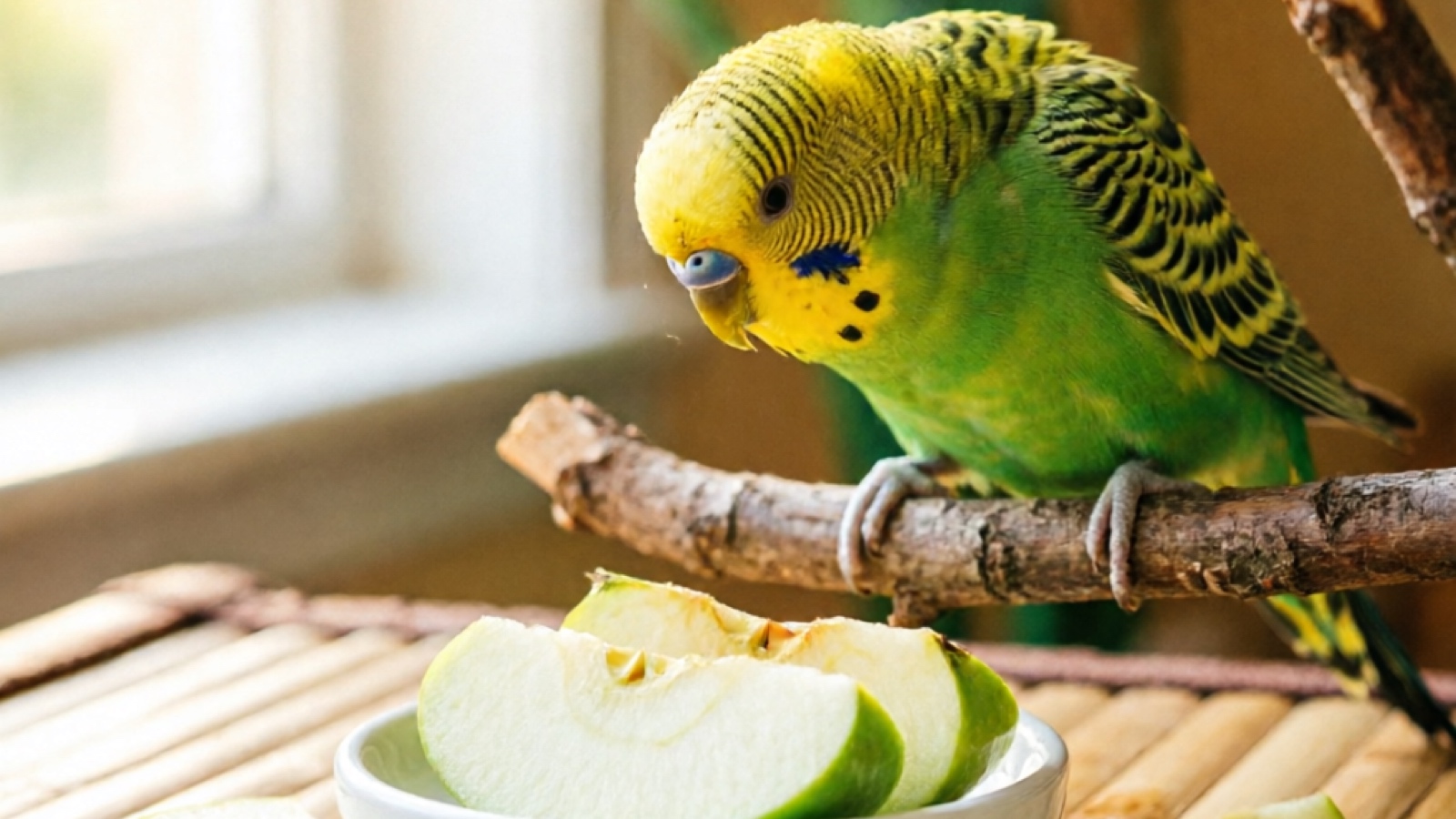
Offer apple pieces in a small, clean dish separate from the main seed or pellet bowl. This prevents the juice from making dry food damp and moldy. I’ve found that placing a small piece of apple on a foraging platform or in a treat holder encourages natural foraging behavior.
Step 7: Remove Uneaten Pieces After 2 Hours
Cut apples brown and spoil at room temperature. Remove uneaten pieces after 2 hours (1 hour during warm weather). Spoiled fruit can harbor bacteria that cause crop infections.
What to Avoid
Apple Seeds (Under Any Circumstances)
This cannot be overstated: apple seeds are toxic to budgies. Even a single crushed seed poses a risk. Never cut carelessly, never offer a core, and never assume your budgie will “spit out” the seeds. Birds don’t understand seed toxicity — they’ll eat whatever you give them.
Apple Cores
The core houses the seeds and stem, both of which contain cyanogenic compounds. Discard the entire core. There is no safe part of an apple core for a budgie.
Applesauce and Juice
Most commercial applesauces contain added sugar or preservatives. Even plain, unsweetened applesauce lacks the beneficial fiber of whole apple and is too concentrated in sugar. Apple juice is even worse — concentrated sugar without fiber to slow absorption. Whole apple pieces are always the better choice.
Cooked, Baked, and Dried Apples
Baked apples prepared for humans contain butter, sugar, or spices harmful to budgies. Dried apples concentrate sugar to approximately 50g per 100g — nearly five times fresh apples — and the chewy texture risks crop impaction. Raw, fresh apple only — always.
Flavored or Candy Apples
Candy apples, caramel apples, or any processed apple product contains sugar, additives, and potentially toxic ingredients. Plain, raw apple only — always.
Daily Feeding
While apples are one of the better fruit choices, they should still be a treat, not a daily staple. Two to three times per week is the right frequency. Overfeeding any fruit — even apples — displaces more nutritious foods (pellets, vegetables) from the diet and gradually increases sugar-related health risks.
Feeding Apple as the Only Fruit
Apples are a great foundation for fruit rotation, but your budgie benefits from nutritional variety. Rotate apples with blueberries, strawberries, small melon pieces, and other safe fruits. Each fruit offers a different nutrient profile, and variety supports broader nutritional coverage.
Safer Alternatives and Rotation Partners
Best Fruits for Regular Rotation (2-3 Times Per Week)
- Blueberries — excellent antioxidants, similar sugar to apples (10g), perfect budgie-bite size. 1-2 berries per serving.
- Strawberries — very low sugar (4.9g), high vitamin C (58.8mg). Half a strawberry is plenty.
- Apples — moderate sugar (10.4g), good fiber (2.4g), great crunch. 1-2 thin slices.
- Melon (cantaloupe) — low sugar (7.9g), high vitamin A, excellent hydration. Small cube.
Good Fruits for Weekly Rotation (1-2 Times Per Week)
- Mango — high vitamin C (36.4mg), moderate sugar (13.7g). Small piece only.
- Papaya — contains papain enzyme for digestion, low sugar (7.8g). Small piece.
Rare Treats (1-2 Times Per Month)
- Banana — moderate sugar (12.2g), many budgies love it. Tiny piece only.
- Grapes — high sugar (15.5g), half a small grape, once every 1-2 weeks.
Sample Weekly Fruit Rotation
Monday: 1 thin apple slice Tuesday: 1 blueberry Wednesday: (no fruit — vegetable day) Thursday: half a strawberry Friday: 1 thin apple slice Saturday: small melon cube Sunday: (no fruit — vegetable day)
This rotation keeps total fruit frequency at 4 days per week with moderate sugar exposure. Adjust based on your budgie’s weight and overall health.
Vegetables Should Outnumber Fruit
The healthiest budgie diets feature vegetables far more frequently than fruit. Dark leafy greens, grated carrots, broccoli florets, bell pepper strips, and cooked sweet potato should be near-daily staples. Fruit is the enjoyable garnish, not the nutritional foundation. For comprehensive guidance, see our budgie diet guide, bird diet guide, and cockatiel care for broader avian nutrition principles. For cage and enrichment setup, see bird cage, best parakeet cage, and bird training.
Other Foods Your Budgie Can Eat
Each link leads to a full safety guide with serving recommendations.
Fruits
- Can Budgies Eat Grapes?
- Can Cockatiels Eat Apples? (same preparation, different portions)
- Can Budgies Eat Spinach? (leafy green guidelines)
Core Guides
- Budgie Diet Guide | Bird Diet Guide
- Cockatiel Care | Parakeet Care
- Bird Cage Setup | Best Parakeet Cage
- Best Cockatiel Cage | Best Cockatiel Toys
- Bird Training
Budgie Behavior
Cockatiel Behavior
Product Recommendations
Here are some products mentioned in this guide:
Frequently Asked Questions
Can budgies eat apples?
Yes, when prepared correctly. Remove all seeds and the core, wash thoroughly (peel if not organic), and cut into small bite-sized pieces. Offer 1-2 thin slices two to three times per week. Apples provide vitamin C, fiber, potassium, and hydration, making them one of the better fruit choices for budgies.
Can budgies eat apple seeds?
No. Apple seeds contain amygdalin, which releases hydrogen cyanide when digested. For a 25-40g budgie, even one or two crushed seeds can be dangerous. Always cut around the core, remove every seed, and inspect the cut pieces before serving. Discard the entire core.
Can budgies eat apple skin?
Yes, if thoroughly washed. The skin contains more fiber and quercetin (an antioxidant) than the flesh. Organic apples with washed skin are ideal. For conventional apples, peeling is the safer option due to pesticide residue on the skin.
Can budgies eat apples everyday?
No. While apples are lower in sugar than many fruits, daily feeding can still lead to weight gain, digestive upset, and displacement of more nutritious staple foods. Limit apples to two to three times per week, with all treats combined making up less than 10% of total diet.
How much apple can a budgie eat?
One to two thin apple slices per serving, two to three times per week. For small budgies (25-30g), a single thin slice is enough. English budgies (40-63g) can have two small slices. Each thin slice contains roughly 0.3-0.5g of sugar, which fits within a budgie’s daily treat sugar budget.
Can budgies eat applesauce?
Only plain, unsweetened applesauce with absolutely no additives — but whole apple pieces are always better. Applesauce lacks the fiber of whole apple, and the mushy texture isn’t ideal for budgies who prefer foods they can grip. Most commercial brands contain sugar or preservatives and should be avoided.
Can baby budgies eat apples?
No, under 8 weeks. Introduce fruit only after 8-12 weeks, starting with tiny amounts. Apples are a good first fruit to try because of their mild, non-acidic flavor. Start with a piece smaller than a sunflower seed and monitor droppings for 24 hours.
What fruits are better than apples for budgies?
Apples are actually one of the better fruit choices for budgies due to their moderate sugar content. Blueberries offer more antioxidants, strawberries provide more vitamin C with less sugar, and melon has lower sugar and higher vitamin A. But apples score well on the sugar-to-nutrition ratio and serve as an excellent foundation for your budgie’s fruit rotation.