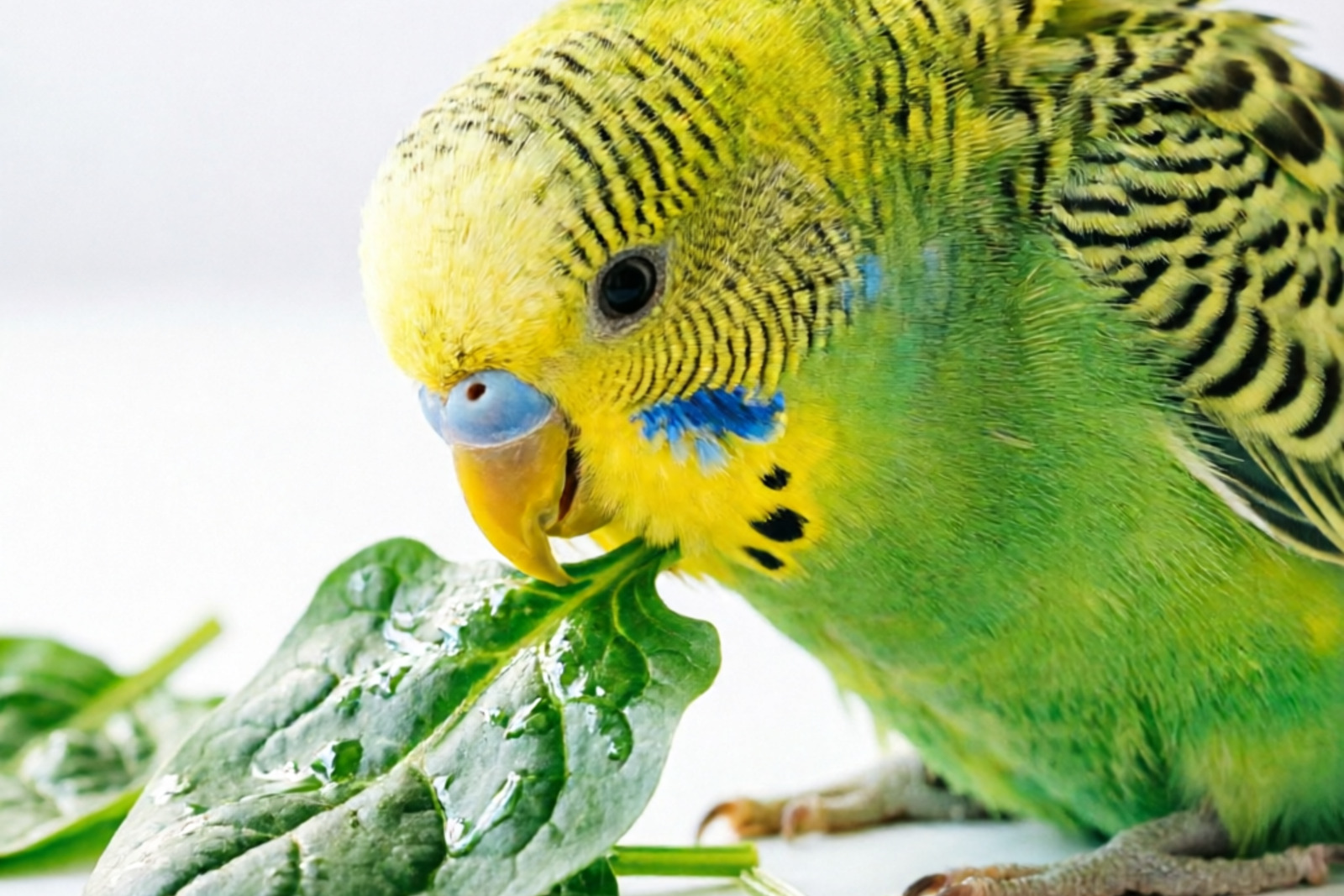
Quick Answer: Can Budgies Eat Spinach?
Yes — budgies can eat spinach, but only in moderation. The reason for caution is oxalates.
TL;DR: Feed 1-2 small, washed baby spinach leaves once or twice per week. Baby spinach is preferred because it has lower oxalate levels than mature leaves. Never feed spinach daily — oxalates accumulate over time and can interfere with calcium absorption.
Spinach is one of the most nutrient-dense leafy greens available, which is exactly why it needs careful handling with budgies. When owners ask can budgies eat spinach, the answer hinges on understanding oxalates. A budgie weighs only 25-40 grams — tiny compared to humans — so compounds that are harmless to us can have a much stronger effect at their scale. The oxalates in spinach bind to calcium in your budgie’s digestive tract, forming insoluble calcium oxalate that the body cannot absorb. Over time, excessive spinach feeding can lead to calcium deficiency, which is particularly dangerous for female budgies that need extra calcium for egg production.
So can budgies eat spinach safely? Yes — as part of a varied budgie diet that includes pellets, seeds, and a rotation of fresh vegetables, spinach is a safe and nutritious treat. The key is treating it as an occasional leafy green, not a daily staple.
Nutritional Value of Spinach for Budgies
Dr. Harvey’s Incredible Canary Blend is a quality option worth considering for your setup.
Key Nutrients
Spinach is packed with vitamins and minerals that benefit budgies. Nutritional data from the USDA FoodData Central — Spinach, raw:
| Nutrient | Per 100g Spinach | Benefit for Budgies |
|---|---|---|
| Calories | 23 kcal | Very low calorie |
| Vitamin A | 9,377 IU (188% DV) | Feather quality, eye health, immune function |
| Vitamin C | 28.1 mg (31% DV) | Immune support, antioxidant |
| Vitamin K | 483 mcg (403% DV) | Blood clotting, bone health |
| Iron | 2.7 mg (15% DV) | Blood health, oxygen transport |
| Calcium | 99 mg (8% DV) | Bones, beak, egg shell formation |
| Folate | 194 mcg (49% DV) | Cell function, feather growth |
| Magnesium | 79 mg (19% DV) | Muscle and nerve function |
| Potassium | 558 mg (12% DV) | Heart and muscle function |
| Water | ~91% | Hydration support |
| Fiber | 2.2g | Digestive health |
| Oxalate | 750-970 mg | Binds calcium — this is the concern |
The oxalate number is what separates spinach from safer leafy greens. At 750-970mg per 100g, spinach ranks among the highest-oxalate vegetables commonly available. For a 30-gram budgie, even a single large mature leaf represents a meaningful oxalate dose relative to body weight.
Spinach vs Other Leafy Greens for Budgies
| Leafy Green | Oxalate (mg/100g) | Vitamin A (IU) | Calcium (mg) | Best For |
|---|---|---|---|---|
| Spinach | 750-970 | 9,377 | 99 | Occasional treat |
| Kale | 20-150 | 9,990 | 254 | Regular feeding |
| Romaine lettuce | 1-3 | 8,710 | 33 | Daily feeding |
| Bok choy | 20-50 | 4,468 | 105 | Regular feeding |
| Swiss chard | 600-900 | 6,116 | 51 | Occasional treat |
| Collard greens | 40-200 | 6,677 | 232 | Regular feeding |
Key insight: Kale delivers similar vitamin A levels to spinach with significantly lower oxalates — making it a better everyday green for budgies. Spinach earns its place as a weekly nutrient booster, not a daily vegetable.
Oxalates: What Every Budgie Owner Needs to Know
Many owners find that Canary Cuisine Canary Food works well for their pet’s needs.
This is the most important section in this article. Understanding oxalates is what separates informed budgie owners from those who accidentally create nutritional problems over time.
What Are Oxalates?
Oxalates (also called oxalic acid) are naturally occurring compounds in many plants. In the digestive system, oxalates bind to calcium to form calcium oxalate — an insoluble compound the body cannot absorb. This creates three problems:
- Calcium from food gets blocked — oxalates “steal” calcium from whatever your budgie eats alongside the spinach
- Calcium deficiency develops gradually — weak bones, soft beak, poor egg shell quality in females
- Calcium oxalate crystals can accumulate — potentially forming kidney or urinary tract deposits
This mechanism is well-documented in avian veterinary nutrition. Female budgies are at particular risk because they need extra calcium for egg production. A calcium-deficient hen may produce soft-shelled eggs or become egg-bound — both serious medical emergencies.
Baby Spinach vs Mature Spinach
Baby spinach is the better choice for budgies. This distinction matters more than most owners realize.
| Characteristic | Baby Spinach | Mature Spinach |
|---|---|---|
| Oxalate content | 400-600 mg/100g | 750-970 mg/100g |
| Leaf size | Small (2-4cm) | Large (10-30cm) |
| Texture | Tender, soft | Tougher, fibrous |
| Budgie preference | Usually preferred | May be too tough |
| Portion control | Natural — 1 leaf = 1 serving | Need to tear or chop |
| Bitterness | Mild | More pronounced |
Baby spinach gives you lower oxalates, easier portion control, and a texture that most budgies find more appealing. If your pet store or supermarket offers a choice, always reach for the baby spinach.
Is Spinach Toxic to Budgies?
For this purpose, RoudyBush Daily Maintenance is a popular choice among pet owners.
No. Spinach is not toxic to budgies.
There is a common misconception among some budgie owners that spinach is poisonous to birds. This is incorrect. Spinach contains no known toxins that are harmful to budgies. The real issue is oxalate content, which affects calcium absorption — not toxicity.
What matters is frequency and portion size. A budgie eating a small amount of spinach once or twice per week gets the nutritional benefits — vitamin A, iron, folate — without the oxalate downside becoming a concern. A budgie eating spinach daily, on the other hand, is at risk of gradual calcium depletion.
The confusion likely stems from spinach’s high oxalate levels being mischaracterized as “toxicity.” Oxalates are an anti-nutrient, not a poison. They interfere with mineral absorption but do not cause acute poisoning in the way that avocado, chocolate, or onion would.
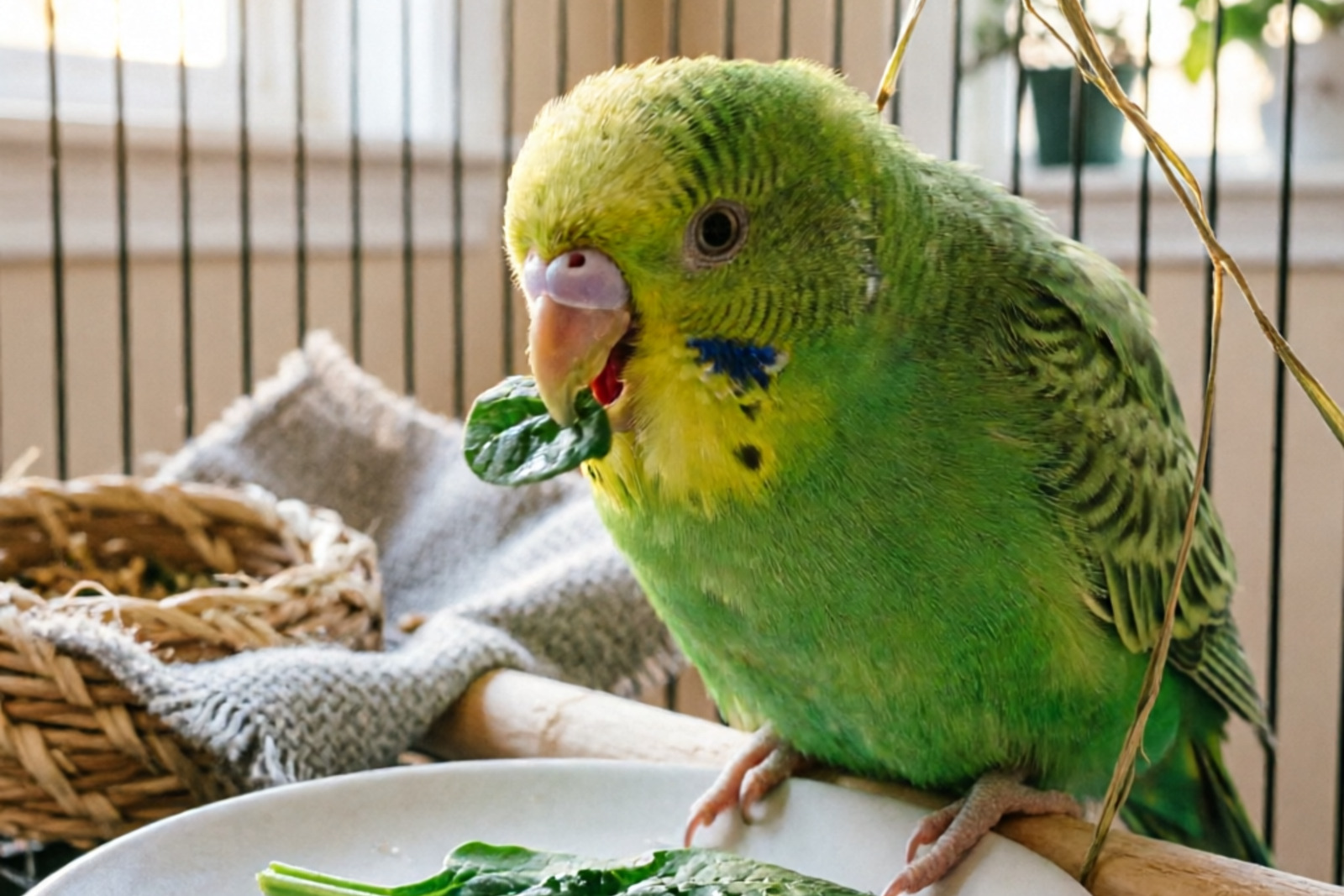
How to Prepare Spinach for Your Budgie
Step 1: Choose Baby Spinach
Baby spinach is preferred for its lower oxalate content and tender texture. Select fresh, vibrant green leaves with no yellowing, wilting, or slimy spots. Organic is recommended since spinach frequently appears on the EWG’s “Dirty Dozen” list for pesticide residue.
Step 2: Wash Thoroughly
Rinse each leaf under cool running water for 15-20 seconds, gently rubbing the surface to remove any soil or pesticide residue. For extra assurance, soak in a vinegar-water solution (1 part vinegar to 3 parts water) for 1-2 minutes, then rinse thoroughly. Pat dry with a clean paper towel.
Step 3: Remove Stems (Optional)
Spinach stems are safe for budgies but many birds find them too tough to eat. Most budgies will nibble the leafy portion and leave the stem behind. You can leave the stem on if your budgie seems to enjoy it.
Step 4: Tear or Leave Whole
Baby spinach leaves are usually the right size for a budgie — serve them whole or torn in half. If using mature spinach, tear leaves into small, manageable pieces roughly the size of your budgie’s head.
Step 5: Serve at Room Temperature
Cold spinach straight from the refrigerator can be unappealing to budgies. Let it sit at room temperature for 5-10 minutes before offering.
Step 6: Remove Uneaten Spinach After 2-4 Hours
Fresh greens wilt and spoil quickly in a warm cage. Budgies may also stash spinach in corners or food dishes where it can harbor bacteria. Remove anything your budgie hasn’t eaten within two to four hours.
How Much and How Often: Safe Serving Guide
| Budgie Type | Serving Size | Frequency | Notes |
|---|---|---|---|
| Adult budgie (25-40g) | 1-2 small baby spinach leaves | 1-2 times per week | Well tolerated |
| Juvenile (<6 months) | 1 small leaf | 1 time per week | Introduce gradually |
| Breeding hen | 1 small leaf | 1 time per week | Extra caution — calcium needs are high |
| Senior budgie (8+ years) | 1 small leaf (torn small) | 1 time per week | Softer texture preferred |
Never feed spinach on consecutive days, and avoid pairing it with other high-oxalate greens like Swiss chard on the same day. Rotate spinach with lower-oxalate alternatives throughout the week.
For budgies that are new to fresh vegetables, start with a tiny piece and observe for 24 hours before offering more. Some budgies take time to accept new foods — patience is essential. For a complete guide on transitioning your budgie to fresh foods, see our budgie diet guide.
Spinach vs Kale vs Romaine: Which Green Is Best?
| Factor | Spinach | Kale | Romaine Lettuce |
|---|---|---|---|
| Oxalate | 750-970 mg | 20-150 mg | 1-3 mg |
| Vitamin A | 9,377 IU | 9,990 IU | 8,710 IU |
| Vitamin C | 28.1 mg | 120 mg | 24 mg |
| Calcium | 99 mg | 254 mg | 33 mg |
| Iron | 2.7 mg | 1.6 mg | 1.2 mg |
| Feeding frequency | 1-2x per week | Daily safe | Daily safe |
| Best for | Weekly nutrient boost | Everyday green | Everyday hydration |
My recommendation: use kale or romaine as your budgie’s everyday leafy green — they have low oxalate content and excellent nutrition profiles. Spinach serves as a once- or twice-weekly nutrient boost for its high iron and vitamin A content. The variety ensures your budgie gets a broad spectrum of nutrients without overloading on any single anti-nutrient.
If you could only pick one leafy green for a budgie, kale would be the top choice — high in everything budgies need, low in oxalates, and most birds accept it readily. But spinach has a valuable place in a rotating vegetable lineup.
Signs of Overfeeding Spinach
Oxalate-related problems develop gradually over weeks or months of excessive spinach consumption:
- Soft or rubbery beak — calcium depletion affects beak quality
- Weak egg shells or egg binding (females) — calcium is critical for egg formation
- Lethargy and weakness — calcium deficiency affects muscle function
- Poor feather quality — nutritional imbalance manifests in dull, brittle feathers
- Splayed legs or difficulty perching — advanced calcium deficiency
What to do: immediately stop all spinach and high-oxalate foods. Provide calcium-rich alternatives like cuttlebone, mineral block, and low-oxalate leafy greens. If you notice soft beak, egg binding, or any signs of distress, contact an avian veterinarian promptly.
Safe Leafy Green Alternatives
If spinach feels too risky for your budgie, or if your vet has recommended reducing oxalate intake, these alternatives work well:
- Kale — the best everyday green for budgies; high vitamin A, high calcium, low oxalate
- Romaine lettuce — gentle on digestion, good hydration, very low oxalate
- Bok choy — excellent calcium content, mild flavor, most budgies accept it readily
- Collard greens — high calcium and vitamin A, low oxalate
- Broccoli leaves — nutritious, low oxalate, great vitamin C
- Dandelion greens — excellent calcium, often grown pesticide-free
- Watercress — nutrient-dense, mild flavor, safe for regular feeding
These greens can be offered more frequently than spinach — daily for romaine and bok choy, or several times per week for kale and collards. Rotation is key to providing balanced nutrition.
Other Vegetables Your Budgie Can Eat
Each link leads to a full safety guide with serving recommendations.
Leafy Greens
- Can Budgies Eat Kale? — coming soon
- Can Budgies Eat Romaine Lettuce? — coming soon
Colorful Vegetables
- Carrots — shred or chop small
- Bell peppers — all colors safe, seeds are fine too
- Broccoli — florets and stems, raw or lightly steamed
- Sweet potato — cooked, no seasoning
Foods to Avoid
- Avocado — contains persin, fatal to birds
- Onion and garlic — causes hemolytic anemia
- Raw potato and potato eyes — contains solanine
- Rhubarb leaves — extremely high oxalic acid
For a complete list of safe and unsafe foods, see our comprehensive budgie diet guide.
Product Recommendations
Here are some products mentioned in this guide:
Frequently Asked Questions
Can budgies eat spinach?
Yes, budgies can eat spinach in moderation. Spinach is rich in vitamin A, iron, and calcium, but it also contains high levels of oxalates (750-970mg per 100g) that bind to calcium and reduce absorption. Offer 1-2 small, washed baby spinach leaves once or twice per week as part of a varied diet. Spinach is safe but should not be fed daily.
Can budgies eat baby spinach?
Yes — and it is the better choice. Baby spinach contains lower oxalate levels (400-600mg per 100g compared to 750-970mg in mature leaves), has a milder flavor that most budgies prefer, and the smaller leaf size makes portion control effortless. One baby leaf equals one serving.
Can budgies eat spinach every day?
No. Daily spinach consumption can lead to oxalate accumulation, which binds to calcium and may cause calcium deficiency over time. Female budgies are at particular risk because they need extra calcium for egg production. Feed spinach 1-2 times per week and rotate with low-oxalate greens like kale, romaine lettuce, and bok choy.
Can budgies eat cooked spinach?
Raw spinach is the best option for budgies. Cooking does reduce oxalate content slightly by leaching it into cooking water, but it also destroys heat-sensitive vitamins like vitamin C. If you do cook spinach, steam it lightly without any salt, oil, or seasoning. Never feed canned or seasoned spinach.
Is spinach toxic to budgies?
No, spinach is not toxic to budgies. The concern is not toxicity but moderation — the high oxalate content means spinach should be fed in limited amounts. When offered 1-2 times per week as part of a varied diet, spinach is a nutritious and safe leafy green for budgies. If your budgie accidentally eats a large amount of spinach at once, it is unlikely to cause any immediate harm — the risk comes from regular, excessive consumption over time.